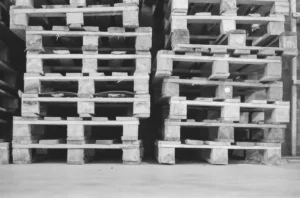
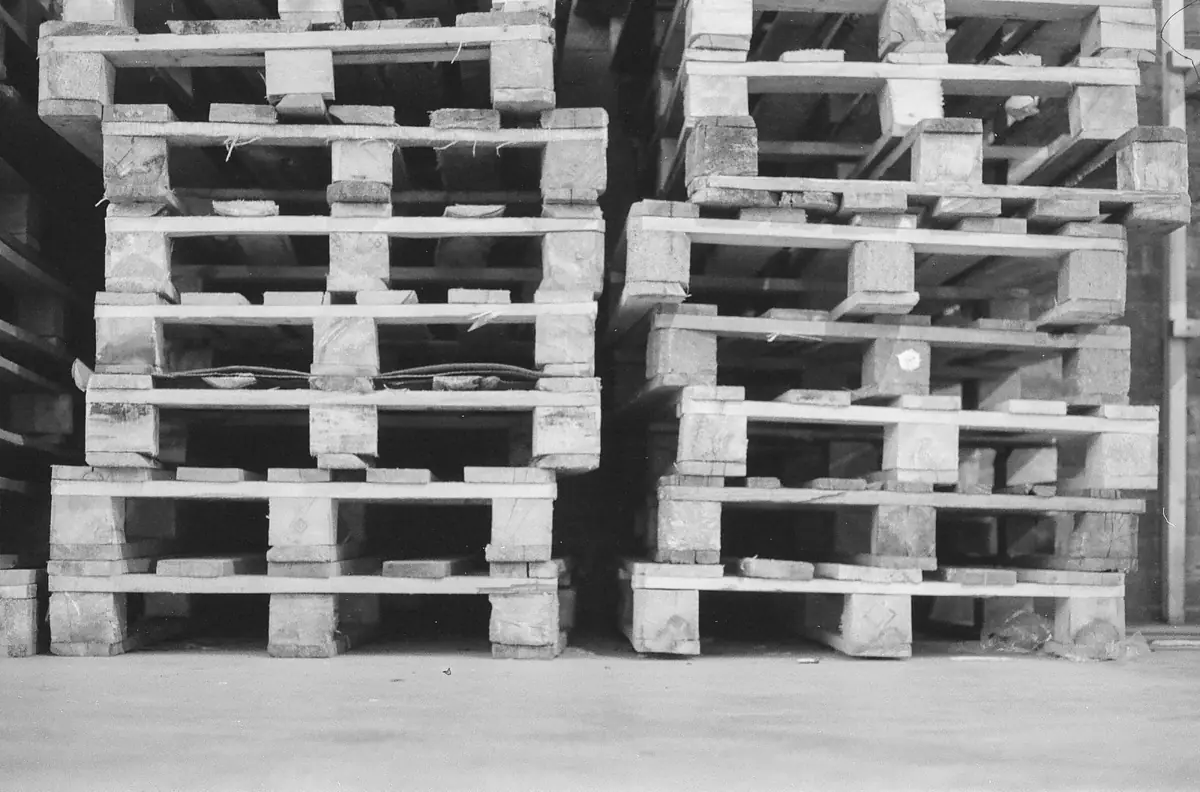
The usual distinction between a wood pallet and a wooden skid is underneath the load: a pallet generally has a top and bottom deck, while a skid typically has a top platform supported by runners without a bottom deck. Suppliers and warehouses sometimes use the names interchangeably, so a drawing is more reliable than the label.
For a purchasing decision, the useful question is how the base will meet the floor, forks, pallet-jack wheels and any storage supports. The bottom-deck difference can affect those interfaces, but it does not establish a load rating by itself.
What the bottom deck changes
The top deck supports the product. The bottom deck connects the lower parts of a pallet and forms part of the surface that meets the floor or other support.
A bottom deck does not have to be a solid sheet. It may consist of separated boards or another specified arrangement. Their position matters: two platforms with the same outside dimensions can have different contact points underneath.
A typical skid rests on its runners instead. That can suit a defined application, but the receiver must understand what those runners will bear on and how the unit will be moved.
| Purchasing question | Wood pallet with a bottom deck | Typical wooden skid without a bottom deck |
|---|---|---|
| What contacts the support surface? | The specified lower deck arrangement | The runners or other lower supports |
| What must the equipment drawing show? | Entry openings, lower boards and wheel paths | Runner positions, openings and wheel paths |
| Is it suitable for a rack or conveyor? | Requires a design and support review | Requires a design and support review |
| Does the name establish capacity? | No | No |
Treat this as a comparison of common constructions. Confirm the supplier's terminology and the actual design before ordering.
Forklift access depends on the complete base
A forklift needs an opening it can enter and a platform that supports the intended load during lifting. The absence of bottom deckboards does not prove that a skid offers unrestricted access. Runners, support positions and the product above them can still limit entry.
Similarly, a pallet with a bottom deck does not automatically allow handling from all four sides. Entry direction is a separate specification.
When comparing a wood pallet vs wooden skid, ask the supplier to identify:
- The approved entry faces.
- Where the forks bear during the lift.
- Any orientation restrictions for the loaded unit.
- The handling conditions used to assess the design.
Keep the equipment operator involved in the review. A drawing that works with one truck, attachment or handling direction may not fit the next stage of the route.
Pallet jacks need a usable wheel path
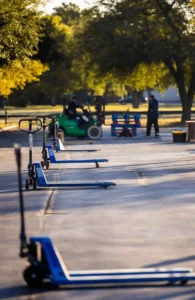
Forklift compatibility and pallet-jack compatibility are different checks. A pallet jack's load wheels must travel into the base and reach the required position as the forks lift.
Bottom boards can affect that travel. A design without a bottom deck may remove one obstruction, while its runners or other geometry may introduce another. Neither “pallet” nor “skid” guarantees a usable wheel path.
For a buying decision, record that the load will be handled by a pallet jack and identify the entry direction. Have the actual equipment and platform drawing checked together. Keep detailed fork, wheel and clearance measurements on the handling specification rather than relying on a broad product description.
This matters when a supplier loads with a forklift but the receiving warehouse unloads or moves the goods with a pallet jack. Confirm both ends of the route before choosing the base.
Floor support and rack support are different conditions
A platform resting on a flat floor does not experience the same support conditions as one spanning a gap between rack beams. Bottom-deck boards and runners change where contact occurs; the effect depends on the entire design and the load placement.
Do not assume a bottom deck makes every pallet rackable. Equally, do not assume a skid can span the same supports as an existing pallet simply because the outside dimensions match.
Where racking is involved, provide the support arrangement, load distribution and orientation to the pallet supplier and the person responsible for the storage system. Ask for confirmation for that specific use.
Conveyors introduce another interface. The base must be suitable for the actual roller or chain arrangement, including transitions. A general pallet-versus-skid comparison cannot substitute for an equipment compatibility check.
Stacking needs its own decision
Two questions are often mixed together: whether empty platforms can be stacked for storage and whether loaded units can be stacked during handling or transport.
For loaded stacking, consider what the upper base will contact below it. Runner contact and a lower-deck arrangement can distribute contact differently. The product or packaging underneath must also tolerate the proposed arrangement.
Ask for the permitted stacking conditions for the actual load. Do not infer them from a platform's name, appearance or performance while resting on the floor.
Inspect platforms before use and remove damaged units from service. A familiar design with broken components is not equivalent to an undamaged platform built to the specification.
Compare the specification before comparing the price
A skid may use less timber than a particular double-deck pallet, but that does not establish a universal price advantage. Dimensions, timber sections, fasteners, quantity and the required support conditions all influence the quotation.
A useful comparison asks both suppliers to quote against the same application. Otherwise, the lower price may describe a different platform, handling route or service requirement.
Supply the following information with the enquiry:
- Product dimensions, packed footprint and gross load weight.
- Whether the weight is evenly spread or concentrated at specific contact points.
- Required top support and the proposed base construction.
- Forklift and pallet-jack entry requirements at each location.
- Floor, rack, conveyor and stacking conditions that apply.
- Expected use cycle and any destination-specific wood-packaging requirements.
Request a drawing showing the underside as well as the top. The skid bottom deck difference should be visible in the specification, rather than left to an assumption between purchasing and receiving.
FAQ
Are a pallet and a skid the same thing?
The terms are sometimes used interchangeably. In the common construction distinction, a pallet has a bottom deck and a skid does not. Confirm the drawing and underside arrangement with the supplier.
Is a pallet stronger than a skid?
The label alone cannot answer that. Timber, fasteners, geometry, load distribution and the support conditions determine the required design assessment. Compare suitability for the same application.
Can a pallet jack move a wooden skid?
Possibly, if the particular base and pallet jack are compatible. Verify entry, wheel travel and lifting clearance with the equipment and platform drawing. A runner-only base is not an automatic guarantee.
Does a bottom deck make a pallet suitable for racking?
No. Racking suitability must be confirmed for the actual supports, span, load and orientation. Floor handling performance does not establish rack performance.
Request a Custom Pallet Quote for Your Handling Route
Comparing a wood pallet with a runner-only base? Share the proposed underside drawing, product footprint, load weight and handling route with AR Pallets. Identify where forklifts, pallet jacks, racks, conveyors or loaded stacking form part of the application.
Request a custom pallet quote from AR Pallets and ask which offered wood-pallet configuration suits those requirements. Confirm pricing and availability through the quote, with the base arrangement shown clearly in the specification.