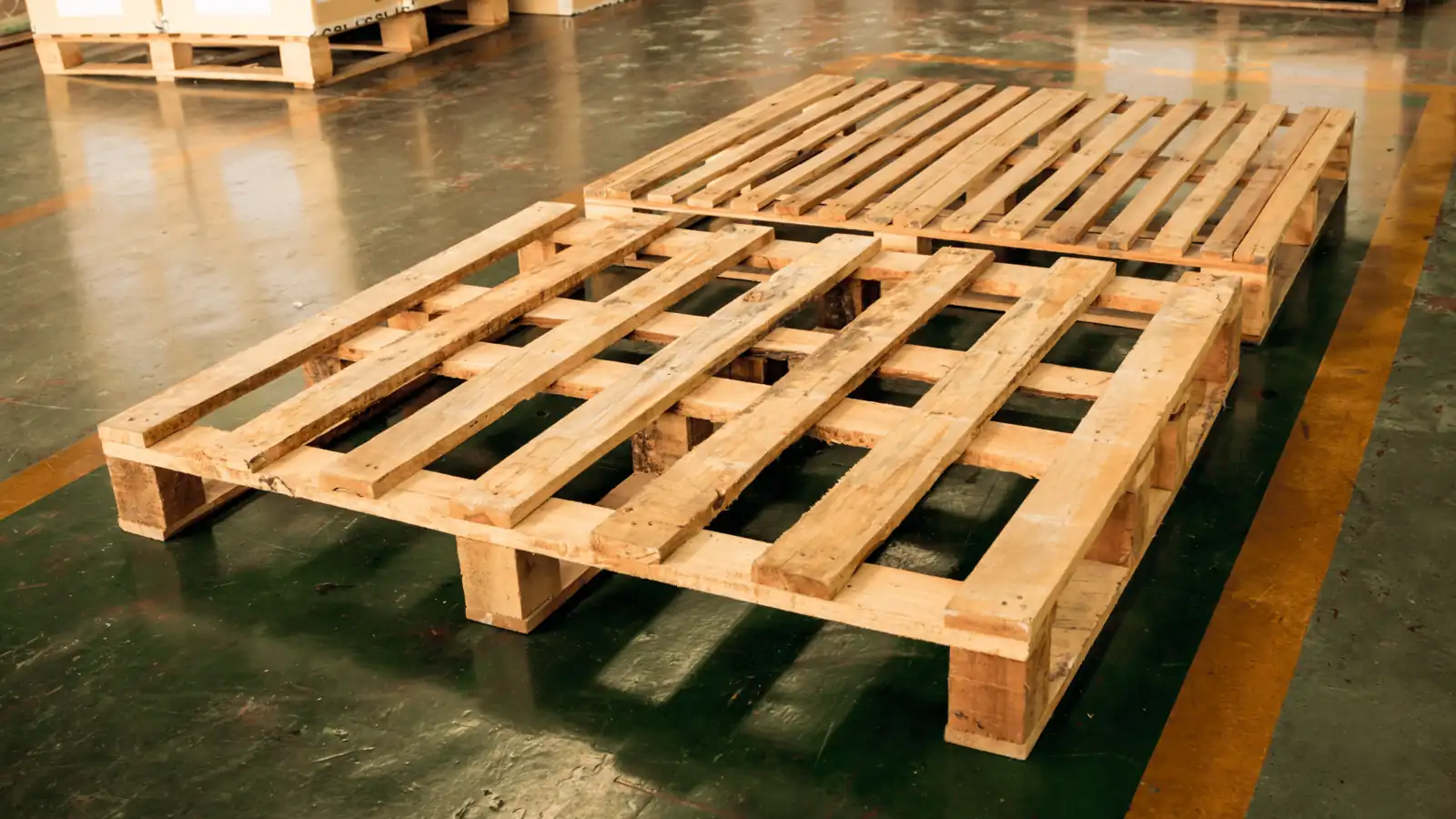
Pallet deck board spacing affects how well cartons are supported from the warehouse floor to the final unloading point. If the openings between boards do not match the footprint of the cases above them, carton corners and edges can sit over unsupported spaces. That can contribute to sagging, shifting, torn packaging, or an unstable unit load.
There is no single deck board gap that works for every shipment. The right layout depends on the carton dimensions, packing pattern, weight distribution, handling method, and shipping conditions. A custom pallet should be planned around the product it carries rather than treated as a standard platform with interchangeable spacing.
Why Carton Footprints Matter
A carton footprint is the length and width of the package where it contacts the pallet deck. That contact area determines where the pallet must provide support.
The important question is not simply how many deck boards are used. It is whether the boards sit beneath the parts of the cartons that carry the load. Strong support normally needs to account for:
- Carton edges and corners
- Seams or closures on the bottom of the carton
- Open spaces between cartons in the layer pattern
- Areas where weight is concentrated inside the package
- Cartons placed along the outside edge of the pallet
Two unit loads can use pallets with the same outside dimensions but need different deck layouts. A layer of small cartons may place several carton edges across one section of the deck. A few large cases may create longer unsupported spans. Mixed carton sizes can make the pattern more complex because contact points change from one part of the load to another.
What Happens When Pallet Deck Gaps Are Too Wide?
Wide pallet deck gaps can leave part of a carton without wood beneath it. Whether that becomes a problem depends on the carton and the product, but common risks include:
- The bottom panel bowing into an opening
- Corners losing support during movement
- Cartons tilting as the load settles
- Stretch wrap carrying more of the stabilizing work
- Pressure becoming concentrated on fewer boards
- Damage increasing after repeated forklift handling or long storage periods
These problems may not be obvious when a pallet is first loaded. Compression, vibration, humidity, and multiple handling points can expose weaknesses later in the trip.
Narrower gaps are not automatically the best answer. Adding unnecessary boards increases pallet weight and material use. The goal is to place enough wood in the right locations for the specific load.
Information to Review Before Choosing Deck Board Spacing
1. Carton length, width, and orientation
Record the dimensions of the carton base and how each carton will face on the pallet. Rotating a carton can change where its edges cross the deck boards. The full layer pattern is more useful than the dimensions of one case by itself.
2. Cartons per layer
Map how the cartons meet one another and where gaps appear within the layer. Interlocking patterns may distribute contact differently from column-stacked cartons. If the pattern changes between products or orders, the pallet design may need to accommodate more than one arrangement.
3. Weight distribution
Total load weight matters, but so does the location of that weight. A carton with a dense product on one side may place more pressure on one deck board. Suppliers need accurate load information instead of an average that hides concentrated weight.
4. Carton construction
Corrugated board grade, bottom-panel design, internal dividers, and the product inside the carton all affect how well a case spans an opening. A rigid package can behave differently from a carton containing loose, flexible, or unevenly distributed goods.
5. Storage and handling conditions
Consider whether the pallet will be floor-stacked, stored in racking, moved repeatedly, or exposed to moisture and temperature changes. Also identify the equipment used to handle it. The pallet and the load must work together through the entire handling process.
Matching Common Carton Patterns to Wood Support
The examples below are starting points for a design conversation rather than fixed engineering specifications.
Small cartons in a dense layer
Small cases can create many contact lines across the pallet. The deck layout should prevent rows of carton edges from repeatedly landing over openings. A supplier may adjust board count, board width, or spacing to create more consistent support beneath the pattern.
Large cartons with broad bottom panels
Large cases can cover several boards, but their centre panels may span wider gaps. The package construction and internal product placement help determine whether additional support is needed through the middle of the carton.
Mixed carton sizes
Mixed loads require a review of the complete pattern, especially if small cartons sit beside larger cases. A pallet designed around only the largest carton may leave smaller packages poorly supported. Standardizing the layer pattern where possible makes the support requirements easier to evaluate.
Cartons with concentrated or irregular contents
When the product does not distribute weight evenly, the deck should support the actual pressure points. Sharing a sample load, packaging drawing, or accurate weight map can help the pallet supplier avoid relying on assumptions.
Deck Board Spacing Is One Part of the Pallet Design
Deck spacing cannot be evaluated separately from the rest of the pallet. Board thickness and width, stringer or block placement, fastener pattern, wood condition, entry direction, and the way the pallet will be stored all affect performance.
Heat treatment is another separate requirement. Heat-treated pallets may be needed for certain international shipments, but heat treatment does not determine the correct deck board spacing for a carton load. The pallet still needs a layout suited to the product and handling environment.
Recycled or remanufactured pallets can also be appropriate for many applications when their condition and specifications match the load. The decision should be based on the required pallet design and the quality of the available stock, not on a general assumption that one pallet type works for every shipment.
How to Brief a Custom Pallet Supplier
Providing complete information early helps a supplier recommend a practical deck layout. Include:
- Carton base dimensions
- Carton weight and total unit-load weight
- Number of cartons per layer and number of layers
- A diagram or photo of the packing pattern
- Product weight distribution, if uneven
- Pallet outside dimensions
- Fork-entry and handling requirements
- Storage method and expected shipping conditions
- Whether the shipment requires heat-treated pallets
- Whether the same pallet must carry more than one carton configuration
Avoid specifying a deck board gap based only on a pallet used for a different product. Even if the pallet dimensions look similar, the carton contact points and handling requirements may not be the same.
Questions to Ask During Pallet Planning
Are smaller deck board gaps always safer?
Not necessarily. The objective is adequate support in the correct locations. Extra boards can add material and weight without solving a problem if they do not align with the carton footprint.
Can changing the carton orientation improve support?
Yes. Rotating cartons or adjusting the layer pattern can change where package edges sit over the deck. Pallet design and load planning should be reviewed together.
Should one pallet design be used for every SKU?
Only when the design has been reviewed against the different carton footprints and load requirements. A shared pallet can simplify operations, but it must still support the most demanding intended configuration.
Does stretch wrap replace proper deck support?
No. Stretch wrap helps contain the unit load, but it does not provide rigid support beneath carton panels. Packaging, load containment, and pallet structure each have different jobs.
Plan the Pallet Around the Product
Deck board spacing works best when it starts with the carton footprint. Reviewing the packing pattern, weight distribution, and handling conditions makes it possible to place wood where the load needs it while avoiding unnecessary material.
AR Pallets supplies custom wood pallets for businesses in Surrey and the Lower Mainland. To discuss carton dimensions, load requirements, and a pallet built to match your operation, explore our custom pallets in Surrey and request a quote based on your specifications.