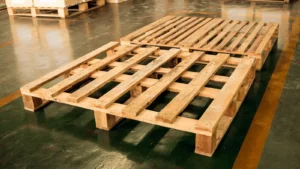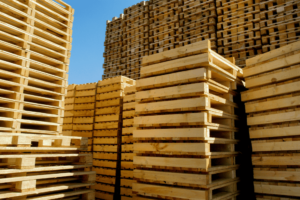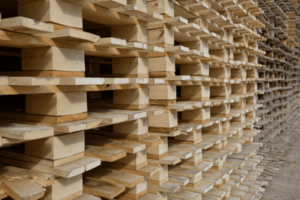

Wood pallet tare weight is the weight of an empty pallet. It belongs in your shipment calculation even though it is not part of the product you are selling. Leaving it out can make a load total inaccurate; counting it twice can inflate the figure just as easily.
The useful starting point is a measured pallet weight for the stock you will actually use. A nominal pallet size does not identify one universal tare weight. Construction, wood and moisture condition can differ, including between pallets with the same footprint.
Separate product, pallet and other packaging
Define what each number includes before adding anything together. For a simple palletized shipment, use three separate categories:
- Product net weight: the goods alone, excluding packaging.
- Pallet tare: the empty wood pallet supporting the load.
- Other packaging: cartons, containers, dividers and load-containment materials not already included in the product figure.
The gross weight of the loaded pallet is the sum of these categories. If your system records the weight of packed cases rather than bare product, that case weight may already include the cartons. Add only the packaging components that remain outside the recorded figure.
Container tare, vehicle weight and a complete loaded-container weight are separate calculations. Confirm the exact figure requested by the carrier instead of treating a pallet total as interchangeable with every transport document’s weight field.
Why two wood pallets can weigh differently
A pallet’s material quantity depends on its design: board thickness and width, the number of deck boards, and the dimensions of stringers or blocks all matter. Repaired and remanufactured pallets may contain different combinations of recovered components.
Wood also holds moisture, so changes in moisture condition affect mass. Drying history alone does not tell you the pallet’s current condition after storage or exposure. The USDA Forest Products Laboratory’s Wood Handbook explains wood properties and moisture behaviour.
Published product weights are useful only within their stated scope. For example, a manufacturer’s specification for a particular pallet design is not an AR Pallets specification and should not be copied into your shipment records for a different pallet.
Measure tare for the pallets you use
- Separate the stock. Group pallets by design, size and condition. Keep visibly different constructions out of the same tare group.
- Check the scale. Use suitable equipment within its capacity and resolution, following your site’s approved weighing procedure.
- Remove unrelated material. Loose packaging, tools or debris should not be included in an empty-pallet measurement.
- Record the result. Note units, date, pallet specification and condition, together with the scale or measurement record.
- Review variation. If sampled pallets differ materially, weigh individual pallets or revise the grouping instead of relying on one old average.
Sampling can help with planning. It does not replace any actual-weighing requirement imposed by your carrier, customer or operating procedure. Where the total shipment must be verified, weighing the finished load avoids assumptions about its components.
Worked example: one loaded pallet
The following figures are hypothetical arithmetic examples, not standard pallet weights or AR Pallets product specifications.
- 40 units of unpackaged product at 12 kg each: 480 kg
- 40 empty cartons at 0.5 kg each: 20 kg
- One empty pallet, measured: 23 kg
- Other packaging and containment, measured: 2 kg
Gross loaded-pallet weight = 480 + 20 + 23 + 2 = 525 kg.
If the warehouse system already records each packed carton as 12.5 kg, use 40 × 12.5 = 500 kg for the packed cases, then add 23 kg and 2 kg. The answer is still 525 kg. Adding another 20 kg for cartons would count that packaging twice.
Four identical loaded pallets in this example would total 2,100 kg. If the four pallets have different measured tare weights, sum those actual weights instead of multiplying one pallet’s tare by four. Include any additional shipment-level material separately if it has not already been counted.
Tare weight is not a load-capacity rating
The weight of an empty pallet does not establish how much it can safely carry. A lighter pallet is not automatically weaker, and a heavier pallet is not automatically suitable for a more demanding handling route.
Load capacity depends on the specific design and use conditions. Read our guide to custom pallet weight limits for that separate question. Never use a shipment-weight calculation as a substitute for confirming the pallet’s suitability for the load and support conditions.
Keep a repeatable shipment record
Use one unit of measurement throughout the worksheet and identify any conversions. Keep the pallet count, measured tare, packed-product total, extra packaging and final total together. Recheck the record when suppliers, pallet designs, packaging or storage conditions change.
For a pallet specification enquiry, explore custom pallets in Surrey. Share your footprint, product and packaging weights, handling route and any tare-weight constraint with AR Pallets so the team can discuss an appropriate wood pallet specification.