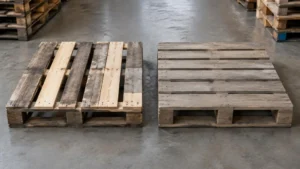
Heat-treated and kiln-dried pallets address different purchasing requirements. Heat treatment controls specified wood pests under a phytosanitary programme. Kiln drying reduces moisture in the wood. A pallet can meet both requirements, but one label should not be used as proof of the other.
For warehouse and shipping buyers, the practical task is to specify two things separately: the treatment and marking needed for the shipping route, and the moisture condition needed for the product and handling environment.
What does heat-treated mean?
For conventional heat treatment under Canada’s wood packaging programme, the wood must reach at least 56°C throughout its profile, including the core, for at least 30 continuous minutes. Treatment, production and marking are controlled through the certification programme; simply warming wood in a kiln is not sufficient evidence.
The Canadian Food Inspection Agency’s D-13-01 directive explains the Canadian programme. Buyers should confirm the requirements for their destination and route before ordering.
Heat treatment does not specify a universal final moisture percentage. An HT mark should therefore not be read as a promise that a pallet is dry enough for every moisture-sensitive shipment.
What does kiln-dried mean?
Kiln drying removes moisture under controlled conditions. Buyers may request it when moisture content, dimensional consistency or the packaging environment matters to their operation. However, the phrase “kiln-dried” alone does not tell a receiving team what moisture level was achieved or when it was measured.
The IPPC explanatory document for ISPM 15 distinguishes kiln drying from phytosanitary treatment. A drying process can also satisfy heat-treatment requirements when the required conditions and official controls are met. The drying label itself does not demonstrate compliance.
Compare the evidence behind each claim
- Heat-treatment requirement: ask about the applicable certification programme and the finished pallet’s ISPM 15 marking.
- Moisture requirement: agree a measurable acceptance condition, sampling method and point of measurement.
- Both requirements: include both on the purchase specification and receiving checklist.
A purchase order that says only “dry export pallets” leaves room for different interpretations. A clearer brief identifies the destination, pallet drawing or dimensions, load details, treatment requirement and agreed moisture criteria.
Check the finished pallet’s treatment mark
Where ISPM 15 applies, inspect the recognised IPPC mark and its country, producer or treatment-provider identifier, and treatment code. Confirm that the supplier can explain the mark and the programme under which it was applied. A standalone KD marking on lumber is not a substitute for the required wood-packaging mark.
Do not add, copy or alter treatment marks yourself. Set aside pallets with unclear markings or uncertain repair histories for supplier review. For the broader export framework, see our guide to ISPM 15 compliant pallets.
Make moisture acceptance measurable
Before selecting a moisture limit, discuss the product, packaging and journey with the people responsible for shipment quality. An arbitrary number copied from another pallet order may not suit the new load.
Record who will measure the wood, which meter and settings they will use, where readings will be taken and how exceptions will be handled. The meter manufacturer’s instructions matter: species, temperature, measurement depth and instrument type can affect readings. A surface that feels dry is not a measurement of the whole component.
Moisture condition can also change after drying. The USDA Forest Products Laboratory’s Wood Handbook covers drying and moisture control. Protect pallets from rain and standing water, and review storage and ventilation with the shipment’s packaging team. Neither HT nor KD is a blanket guarantee against later moisture problems.
Questions to resolve before ordering
- What destination and transit requirements apply to this shipment?
- Is phytosanitary treatment, moisture reduction, or both required?
- What marking and supporting information will accompany the pallets?
- What moisture acceptance method has the buyer agreed?
- How will pallets be stored between receipt, loading and departure?
- Who will review pallets that fail the receiving checks?
Match the order to the route and load
AR Pallets supplies wood pallet options for businesses in Surrey and the Lower Mainland. Explore heat-treated pallets in Abbotsford, or review our pallet services for a regional enquiry.
Share the pallet dimensions, load details, shipping destination and any moisture requirements before requesting a quote. Ask the team to confirm the specifications available for your order rather than assuming every pallet line has the same treatment or drying status.