A pallet that fits your product still needs to fit the equipment moving it. For Surrey warehouses and manufacturers using conveyors or automated handling, choosing a wood pallet involves more than confirming its length and width.
The useful starting point is a documented pallet specification: the dimensions, construction and condition your equipment requires. That gives your operations team and pallet supplier a clear basis for discussing pallet conveyor compatibility.
What do wood pallet dimensional tolerances mean?
A tolerance describes the permitted variation from a specified measurement. Ordering pallets to a nominal size does not, by itself, define how much variation your handling system can accept.
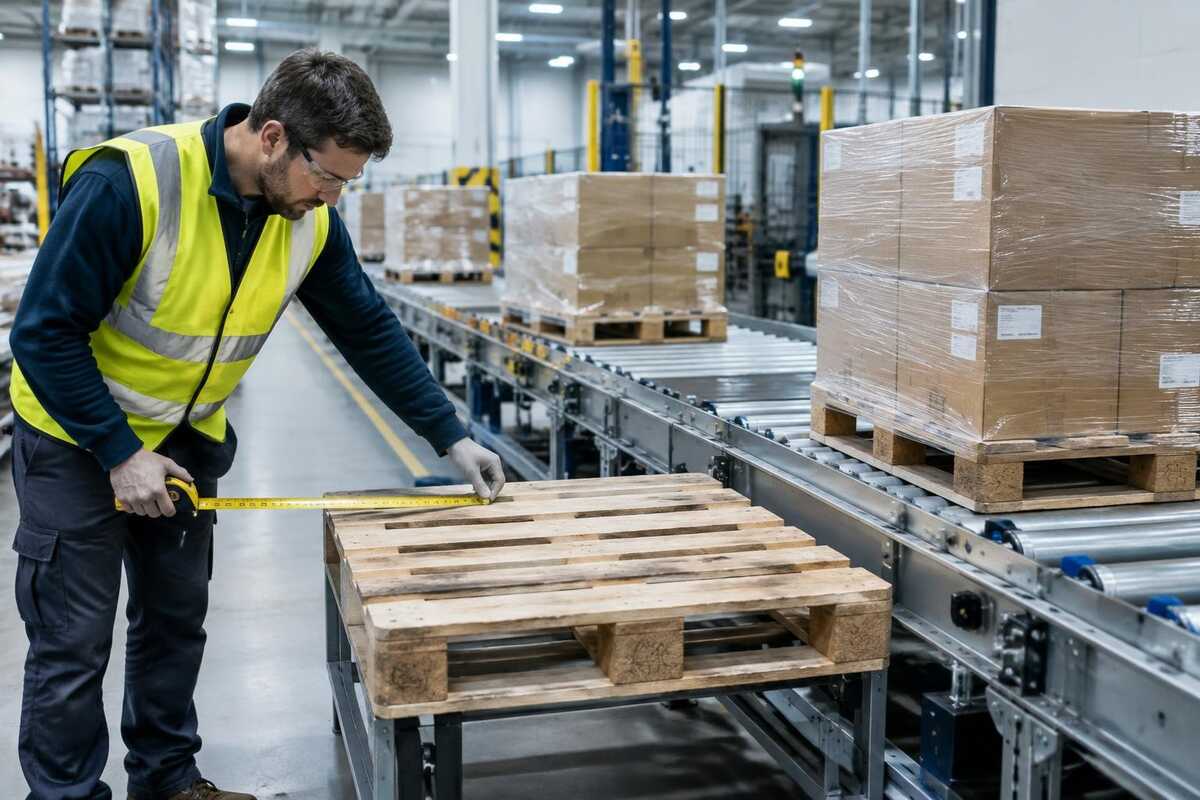
Ask your equipment manufacturer or system integrator for the relevant pallet requirements before placing an order. Record the required measurements and their acceptable limits rather than assuming a general industry dimension will suit every conveyor, transfer or automated handling stage.
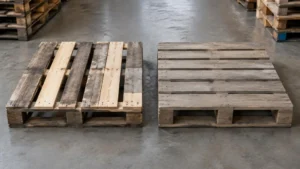
Pallet dimensional consistency also involves construction. Two pallets with the same outer dimensions may have different board layouts, entry openings or underside configurations.
Check the underside as well as the footprint
The underside is where the pallet meets the conveyor. Its configuration and condition deserve particular attention.
Interroll’s conveyor planning guidance explains that uneven bases do not necessarily rest on every roller beneath them. It also identifies geometry, weight and weight distribution as factors in conveyor configuration. This makes the pallet’s actual support surfaces relevant to compatibility—not just its stated footprint. Interroll conveyor planning guidance
When reviewing an equipment drawing, ask which underside features matter to your system. Useful questions include:
- Which pallet construction styles does the equipment accept?
- Where must bottom boards or runners provide support?
- What entry openings and clearances are required?
- Does the pallet travel in more than one orientation?
- Are there additional requirements at transfers, stops or lifting points?
Use the answers to prepare one specification that follows the pallet through the complete handling route.
Include the load in the specification
An empty pallet is only part of the application. Share the product dimensions, expected load weight, weight distribution and handling method alongside the pallet measurements.
For example, record whether the product sits evenly across the deck or concentrates weight in particular areas. Explain how the pallet will be stored and moved before and after the conveyor stage.
AR Pallets’ custom pallets in Surrey are planned around load dimensions, weight, handling equipment, storage and shipping requirements. Providing those details helps the team discuss a suitable construction for your application.
Make pallet condition part of receiving checks
A pallet can match the specified dimensions and still have damage that makes it unsuitable for the line.
Interroll’s pallet conveyor documentation includes checks for complete, undamaged boards, properly seated fasteners and bottom runners free of plastic film. These requirements illustrate why a dimensional check should sit alongside a condition inspection. Follow the requirements for your own equipment when setting acceptance criteria. Interroll pallet conveyor application notes
As a practical receiving procedure, keep the approved drawing available and record any pallets that fall outside your agreed requirements. Separate questionable pallets for review before they enter automated handling.
Plan a trial before a larger order
Discuss a sample or trial batch with your supplier and equipment team before committing to a larger volume. Agree on what will be checked, who will assess the results and how any specification changes will be recorded.
A useful trial plan follows the intended handling route with representative loads under the equipment team’s procedures. Keep the accepted specification and revision date with subsequent orders so purchasing and receiving staff work from the same information.
AR Pallets offers custom, recycled and heat-treated options through its wood pallet services. The appropriate choice depends on the application; confirm specific equipment requirements before deciding which option to order.
Bring your equipment requirements to the quote discussion
Preparing pallets for a conveyor or automated handling system? Send AR Pallets your equipment drawing, required dimensions, load details and quantity through the contact page, or call (604) 396-7884. Ask the team to review your requirements and discuss custom pallet options before production.